
EinScan Rigil
4.8Editor score
Wireless all-in-one solution
Hybrid blue laser IR tech
Onboard computing power
This guide compares the top 3D scanners for reverse engineering based on accuracy, speed, software features, and portability to help professionals choose the
Reverse engineering requires precise digital capture of physical objects to recreate parts or analyze designs. A high quality 3D scanner for reverse engineering ensures you get accurate models without manual measurement errors. The right device saves time and improves workflow efficiency significantly.
We evaluated ten leading scanners focusing on industrial grade accuracy, scanning speed, and software compatibility. Our analysis includes blue laser technology, wireless capabilities, and performance on challenging surfaces like dark or shiny materials. Each product was assessed for its suitability in professional reverse engineering tasks.
Each pick highlights specific strengths such as portability, detailed texture mapping, or metrology grade precision. These selections cover various budgets and use cases from automotive parts to complex mechanical assemblies. Please note that product specifications and availability may change over time so verify details before purchasing.
4.8Editor score

4.9Editor score

4.7Editor score
This table provides a side-by-side comparison of all ten selected scanners highlighting their key technical specifications and primary use cases to help you make an informed decision for your specific reverse engineering needs.



The Revopoint MetroY Ultra stands out as the top choice for professional reverse engineering tasks requiring both speed and precision. With its industrial-grade accuracy of 0.01 mm single-frame precision it captures intricate geometric details flawlessly making it ideal for tight tolerance measurements.
We may earn a commission when you buy through this link, at no additional cost to you.
Its ultra-fast 90 FPS scanning speed significantly reduces data acquisition time without compromising quality. The advanced blue laser technology allows scanning of black and metallic components without spray which protects delicate parts and saves prep time. Outdoor scanning up to 100000 lux ensures versatility in various environments.
While the price is higher than entry-level options the performance gains justify the investment for professionals. The requirement for a powerful NVIDIA GPU is necessary for maximizing the 90 FPS capability which might be a consideration for older workstations.
This scanner is perfect for engineers and manufacturers needing reliable reverse engineering solutions. Its wireless freedom and long battery life make it suitable for fieldwork ensuring you can work efficiently anywhere.
The 90 FPS capability powered by NVIDIA GPU allows rapid large-area scans reducing project timelines significantly.
No-spray scanning for dark or shiny surfaces keeps your workspace clean and protects sensitive industrial components.
We may earn a commission when you buy through this link, at no additional cost to you.
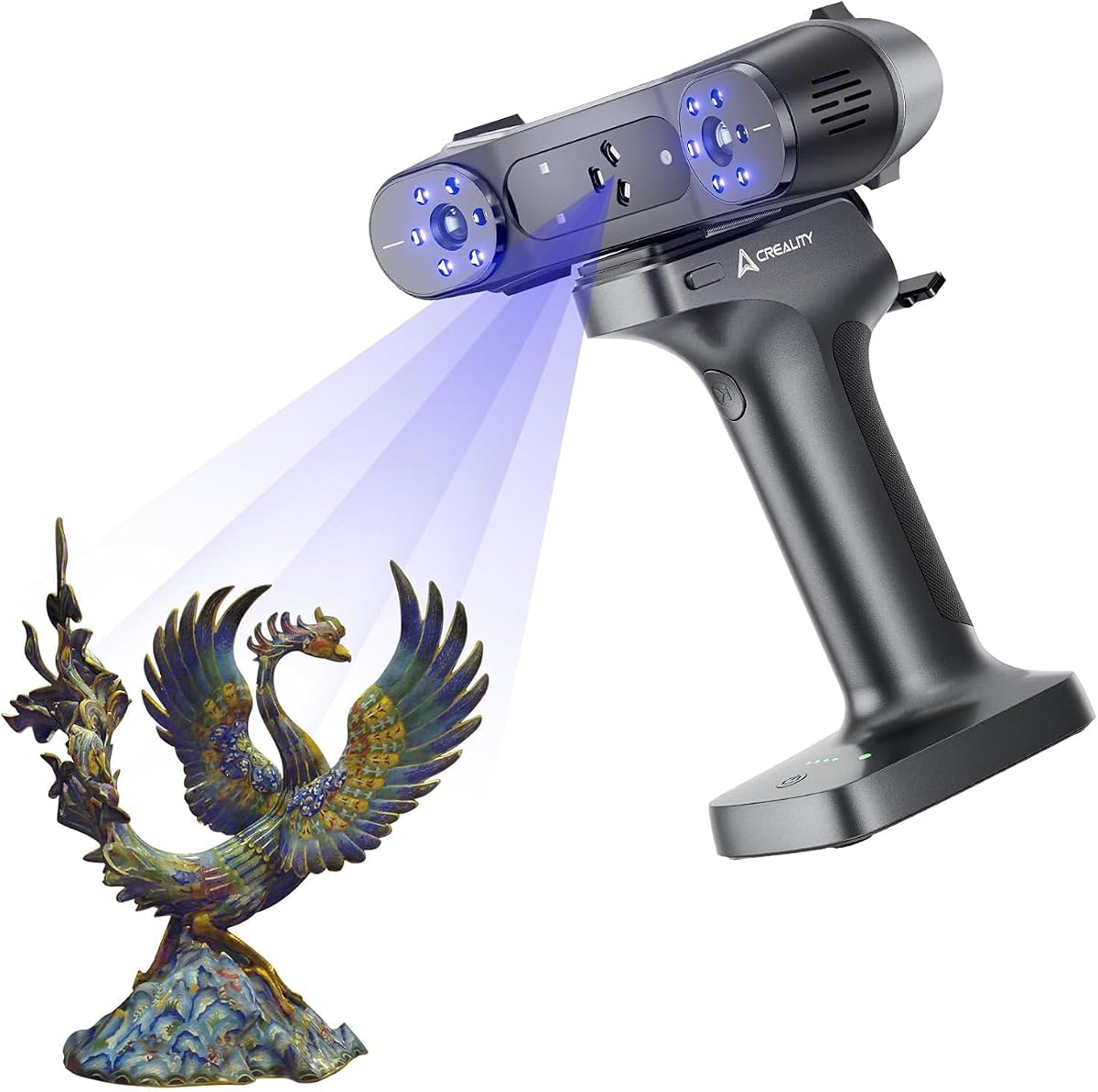
The EinScan Rigil offers a premium wireless all-in-one scanning solution that eliminates the need for external computers during capture. Its hybrid blue laser plus IR VCSEL technology provides ultra-precise 0.04 mm accuracy capturing vibrant textures in high definition for design applications.
We may earn a commission when you buy through this link, at no additional cost to you.
Powered by a 2.4 GHz CPU with 32GB DDR5 RAM and 1TB SSD it ensures smooth operation and fast processing speeds. The 6.4 inch 2K AMOLED touchscreen enhances usability while replaceable batteries allow continuous scanning even in challenging lighting conditions outdoors.
While expensive the included personal one-on-one online training adds significant value for new users. The large size and premium price make it less accessible for small teams but ideal for large enterprises requiring top-tier performance.
Ideal for automotive and engineering applications the Rigil ensures high fidelity even on dark or reflective metal surfaces. Its complete package includes all accessories needed for immediate professional use.
Blue laser and IR VCSEL combined provide precise accuracy and vivid texture capture for complex engineering tasks.
Wi-Fi 6 and onboard computing enable scanning without markers or cables for maximum workflow flexibility.
We may earn a commission when you buy through this link, at no additional cost to you.
The Creality Otter Lite Basic delivers professional-grade accuracy of 0.05 mm at an affordable price point making it accessible for smaller studios or startups. It supports both close-range and long-range scanning modes capturing fine details on objects as small as 20mm with ease.
We may earn a commission when you buy through this link, at no additional cost to you.
Equipped with RGB and infrared cameras it captures true-to-life color textures at up to 30 fps exporting in common formats like OBJ STL and PLY. Weighing just 235g it is highly portable and includes a turntable calibration board and carrying case for immediate use.
While it lacks the ultra-high precision of industrial scanners it is sufficient for many reverse engineering and 3D printing applications. The plug-and-play design and intuitive button controls simplify the scanning process for users with varying technical expertise.
This model is perfect for DIY enthusiasts and professionals needing a portable and cost-effective tool. The complete kit ensures you have everything needed to start scanning immediately without additional purchases.
Close-range and long-range modes allow capturing everything from tiny parts to medium-sized objects efficiently.
Lightweight build and complete kit make it ideal for on-the-go scanning and small workshop environments.
We may earn a commission when you buy through this link, at no additional cost to you.
The Revopoint MetroX Pro offers industrial-grade high-precision scanning capable of capturing every detail with single-frame precision up to 0.01 mm. It features three scanning modes including 30 cross-line lasers for flat shiny surfaces and 62-line full-field blue structured light for marker-free scans.
We may earn a commission when you buy through this link, at no additional cost to you.
PC-to-mobile real-time streaming via the Revo Mirror app allows you to see scans take shape on a tablet without holding a laptop. This flexibility improves workflow efficiency making it easier to detect data gaps and adjust scanning angles dynamically.
While the software is intuitive some advanced features like Revo Design require paid separate purchase which may add to the total cost. The need for a PC connection limits portability compared to standalone wireless models.
This scanner is ideal for precision modeling and industrial measurement tasks where accuracy is paramount. Its ability to scan shiny or dark surfaces without spray makes it versatile for diverse materials.
Streaming scans to mobile devices enables immediate data review and adjustments without being tethered to a laptop.
Volumetric accuracy of 0.02 mm meets strict industrial measurement needs for reliable reverse engineering.
We may earn a commission when you buy through this link, at no additional cost to you.
The Creality CR-Scan Raptor Pro features 22 crossed blue lasers plus 7 parallel blue lasers enabling up to 660000 dots per second scanning speed. It handles objects ranging from 5mm to 4000mm making it suitable for automotive modification and industrial design applications.
We may earn a commission when you buy through this link, at no additional cost to you.
Its all-weather performance ensures stability in high and low temperatures while blue laser technology allows direct scanning of black and metal objects without powder. This saves time and simplifies the scanning process significantly for complex industrial parts.
The system requires a powerful computer with specific GPU and RAM specs which might be a hurdle for existing setups. Proper alignment and calibration are essential for large objects to maintain accuracy across extensive areas.
Ideal for full-size adaptability the Raptor Pro integrates seamlessly with professional 3D design software. Its true-color rendering capabilities enhance realism in digital models for detailed prototyping.
Crossed blue laser light covers wide ranges efficiently reducing repeated scans for medium and large objects.
Built-in RGB camera supports 24-bit full-color texture capture for accurate restoration of surface details.
We may earn a commission when you buy through this link, at no additional cost to you.
The Revopoint INSPIRE 2 weighs only 190g and features dual scanning modules with infrared structured light and multi-line laser modes. It creates highly detailed models with accuracy up to 0.05 mm and precision up to 0.03 mm ensuring consistent data for 3D printing.
We may earn a commission when you buy through this link, at no additional cost to you.
Its outdoor scanning capability works reliably in up to 20000 lux lighting while the adjustable optical zoom helps capture details on mixed-geometry surfaces. The lightweight aerospace-grade aluminum alloy panel offers durability and portability for field work.
While the precision is slightly lower than industrial models it is perfect for detailed modeling and heritage preservation tasks. The wireless interactive streaming allows seamless remote operations and flexibility during scanning sessions.
Ideal for professionals needing a portable and affordable solution the INSPIRE 2 includes everything needed for immediate use. Its user-friendly software simplifies post-processing for efficient end-to-end workflows.
190g weight makes extended handheld scanning comfortable and reduces fatigue during long field sessions.
Infrared laser lines enable scanning in shaded or semi-bright outdoor conditions without losing accuracy.
We may earn a commission when you buy through this link, at no additional cost to you.
This version of the Revopoint MetroX Pro offers single-frame precision of up to 0.01 mm and volumetric accuracy of 0.02 mm plus 0.04 mm times length in meters. It includes four scanning modes to capture flat shiny or dark surfaces efficiently without needing spray.
We may earn a commission when you buy through this link, at no additional cost to you.
The one-click automatic turntable scanning automates 3D scanning of complex objects adding realism with color-accurate scans using the HD RGB camera. Feature tracking marker tracking and global marker modes help capture any object regardless of shape complexity.
Similar to the advanced model it benefits from PC-to-mobile streaming but requires a stable laptop connection for real-time monitoring. The software interface is intuitive but full integration into CAD workflows may require paid additional tools.
Suitable for precision modeling and industrial measurement this scanner handles diverse needs across manufacturing and design. It provides a reliable balance of performance and usability for professional reverse engineering projects.
One-click turntable scanning automates complex object capture saving time on manual positioning and alignment.
HD RGB camera ensures vivid color reproduction for realistic 3D models in Auto Turntable mode.
We may earn a commission when you buy through this link, at no additional cost to you.
The Creality Raptor Pro achieves metrology grade accuracy up to 0.02 mm capturing intricate details at up to 660000 points per second. Its configuration of 22 crossed blue lasers plus 7 parallel blue lasers ensures flawlessly scanning medium to large objects for reverse engineering.
We may earn a commission when you buy through this link, at no additional cost to you.
Outdoor-ready wireless performance withstands up to 100000 lux ensuring high-precision scanning anywhere without a lab requirement. No spray technology protects delicate parts from powder saving prep time and keeping the inspection environment clean for sensitive equipment.
While the software is innovative with step-by-step tutorials and advanced editing tools it relies on specific system requirements like i7 CPUs and 32GB RAM for optimal performance. Proper calibration is necessary to maintain consistent accuracy during repeated scans.
This scanner is perfect for automotive industrial design and medical applications requiring precise measurements. Its robust solution simplifies the entire process from capture to model refinement.
0.02mm accuracy ensures reliable data for tight tolerance measurement and industrial inspection.
High lux tolerance allows consistent scanning even in bright natural outdoor conditions.
We may earn a commission when you buy through this link, at no additional cost to you.
The Creality Raptor X features a wireless handle with seamless data transmission redefining portability in blue laser 3D scanning. It achieves single-frame scanning accuracy up to 0.02 mm and volume accuracy up to 0.02 mm plus 0.06 mm per meter ensuring reliable data for medium to large objects.
We may earn a commission when you buy through this link, at no additional cost to you.
Its large capacity 35400 mWh battery allows scanning to be charged to 80% in just 1.5 hours making outdoor use convenient and worry-free. Anti-shake technology and speckle matching enable smooth handheld scanning without losing tracking on feature-rich workpieces.
While the price is moderate for these specs the requirement for a capable PC system remains necessary for data processing. The unique face and body algorithm allows rapid human scans in as little as two minutes adding versatility for medical uses.
Ideal for engineering parts molds and automobile components the Raptor X provides high-fidelity full-color scanning. Its wireless capabilities and strong material adaptability make it a versatile choice for diverse scanning projects.
WiFi 6 allows rapid data transfer and real-time mirroring on phones without cable constraints.
Large capacity battery supports long field sessions with quick recharge times for continuous work.
We may earn a commission when you buy through this link, at no additional cost to you.
The Creality Raptor Pro offers metrology-grade accuracy up to 0.02 mm plus 0.08 mm per meter combining advanced blue laser technology with infrared structured light. It scans at speeds of 660000 points per second making it perfect for industrial inspection reverse engineering and detailed 3D modeling.
We may earn a commission when you buy through this link, at no additional cost to you.
Dual blue laser mode includes 22 cross laser lines for large coverage and 7 laser lines for partial HD scanning capturing sharper edges and richer details. Objects between 5mm and 4000mm are effortlessly scanned for engineering parts molds and automobile components.
Professional software integration with Windows and macOS allows adjustable resolution and multi-project stitching for seamless 360 scans. While powerful it recommends specific CPU and RAM configurations which might require hardware upgrades for some users.
Suitable for reverse engineering automotive and artifact scanning this model provides a comprehensive toolset. Its wireless support and high precision ensure reliable results for demanding professional tasks.
22 cross lines and 7 parallel lines balance speed and detail for various object sizes.
Wireless support reduces cable clutter and enhances flexibility during detailed scanning operations.
We may earn a commission when you buy through this link, at no additional cost to you.
Selecting the right 3D scanner for reverse engineering involves evaluating precision, speed, compatibility, and environmental capabilities to match your specific workflow demands.
Accuracy and precision determine how closely your digital model matches the physical object. For reverse engineering look for single-frame precision under 0.05 mm and volumetric accuracy metrics that ensure reliable results across larger objects. Industrial applications often require stricter tolerances than general prototyping so check the manufacturer specifications carefully.
Prioritize scanners offering sub-0.02 mm precision for high-quality reverse engineering tasks.
Scanning speed impacts productivity by reducing acquisition time especially for large or complex objects. Models offering 60 FPS or higher allow faster capture and real-time feedback which is useful in dynamic environments. Look for specs like points per second or FPS to compare performance across devices.
Higher frame rates enable faster and more efficient scanning sessions for demanding workflows.
Blue laser and infrared structured light are common in industrial scanners due to better performance on dark and shiny surfaces. This eliminates the need for spray markers which simplifies preparation and protects delicate parts. Ensure the scanner supports marker-free scanning for efficient reverse engineering workflows.
Blue laser technology provides superior accuracy on challenging surfaces without extra preparation.
Portability is crucial if you work outside a fixed lab or need to scan large items on-site. Wireless models with Wi-Fi 6 enable remote operations and reduce cable clutter but may require more battery capacity. Check battery life and onboard computing capabilities for standalone use.
Wireless scanners increase flexibility but check battery duration for uninterrupted field work.
Ensure the scanner can handle your expected object sizes ranging from small parts to full vehicles or assemblies. Dual-mode scanners with close-range and long-range options offer versatility for different reverse engineering scenarios. Verify the scanning volume or range limits before purchase.
Choose models supporting your typical object sizes to avoid multiple passes or equipment limitations.
Software determines your ability to export and edit data for CAD workflows. Ensure compatibility with common formats like STL OBJ PLY or integration with industry tools such as SolidWorks or Geomagic. Some scanners offer paid add-ons for advanced processing so account for total costs.
Compatible software ensures seamless transfer from scanned data to CAD models for engineering.
Full-color texture mapping is important for visual fidelity and detailed reverse engineering where surface features matter. Look for RGB cameras capable of capturing 24-bit color to retain realistic textures in 3D models. This is especially useful for consumer goods or artifact scanning projects.
High-resolution color capture improves model realism for design and visualization applications.
If working outdoors or in variable conditions choose models with temperature compensation and sunlight tolerance. Some scanners maintain accuracy in bright light or extreme temperatures which is critical for field reverse engineering. Check lux ratings and build materials for ruggedness.
Look for high lux tolerance and stable temperature performance for reliable outdoor scanning.
Prepare your workspace by ensuring stable lighting and a clean environment to minimize interference during scanning. Use calibration boards regularly to maintain accuracy especially after moving or shipping the device. Markers may be needed for very reflective or featureless surfaces if the scanner does not support markerless scanning.
Hold the device steadily and maintain consistent distance and angle relative to the object for optimal data capture. Use real-time preview features to identify gaps and adjust scanning patterns accordingly. Slow and steady motion reduces errors compared to fast or erratic movements.
After scanning store the device in a protective case and keep lenses clean with provided microfiber cloths. Charge batteries fully if using wireless models and update firmware regularly for performance improvements. Follow manufacturer maintenance schedules to prolong hardware life and ensure consistent accuracy.
For most professional reverse engineering applications single-frame precision of 0.02 mm or better is recommended. Higher accuracy ensures that critical dimensions and tolerances are captured correctly for manufacturing. Industrial models typically offer precision between 0.01 mm and 0.05 mm depending on their design.
Many modern scanners use blue laser or infrared light to scan without markers especially on feature-rich surfaces. However reflective dark or uniform objects may still require markers for optimal tracking. Check if your chosen scanner supports markerless technology to simplify your workflow.
Yes several advanced scanners support outdoor scanning with sunlight tolerance up to 100000 lux or higher. Models designed for fieldwork often include temperature compensation and battery grips for extended use. Ensure the device is rated for outdoor conditions if you plan to use it outside.
Most scanners export to standard formats like STL OBJ PLY and ASC that work with many CAD and 3D software tools. Some manufacturers provide proprietary software for scanning and basic editing with optional paid modules for advanced CAD integration. Compatibility varies so check software requirements for your workflow.
Scan time depends on object size complexity and scanner speed. Small detailed parts may take minutes while large objects can require longer sessions. Faster scanners capture up to 90 FPS reducing total acquisition time significantly for efficiency.
Most high-performance scanners recommend computers with modern CPUs at least 16GB RAM and dedicated graphics cards. This ensures smooth real-time processing and faster data handling during and after scanning. Check system requirements for optimal performance with specific models.
Yes many scanners support large object sizes up to 4000 mm or more with appropriate modes. Some models include features like face and body scanning for full vehicle or human captures. Check scanning volume limits to ensure suitability for large-scale reverse engineering.
Regular maintenance includes cleaning lenses with provided materials and storing the device properly. Firmware updates help maintain performance and add features so check manufacturer recommendations. Calibration boards are used periodically to ensure consistent accuracy.
The top picks including the Revopoint MetroY Ultra EinScan Rigil and Creality Otter Lite Basic offer strong performance across various budgets and needs. These devices combine precision speed and software features suitable for demanding reverse engineering workflows. Choosing the right model depends on your specific project requirements.
Prioritize accuracy and scanning speed if your work involves tight tolerances and large object volumes. Portability and wireless connectivity may be more important for fieldwork or collaborative teams. Always verify compatibility with your existing CAD tools to streamline the engineering process.
Remember that product availability and features may change over time so check current specifications before purchasing. Investing in a reliable scanner improves efficiency and model accuracy for successful reverse engineering outcomes.