
M-AUDIO M-Track Duo
4.4Editor score
48kHz audio resolution
Two combo XLR inputs
Includes MPC Beats software
Explore our expert guide comparing the top Firewire audio interfaces for PC to help you find the right connectivity solution for your studio setup today.
Finding the right Firewire audio interface for PC can be challenging as modern systems often lack native support. This guide reviews top options to ensure high-quality audio capture and reliable performance for your recording needs.
We evaluated each product based on connectivity standards, driver compatibility, and overall value for musicians and producers. Our analysis covers both legacy expansion cards and modern alternatives that bridge the gap for Firewire devices.
Each selection highlights specific strengths and potential limitations to help you make an informed decision for your workflow. Please note that availability and pricing may change frequently so check current listings before purchasing.
4.4Editor score

4.6Editor score

5.0Editor score
This side-by-side comparison highlights key specifications and features across all selected models to help you quickly identify the best fit for your PC recording environment and budget requirements.





This PCIe expansion card enables Firewire connectivity for Windows desktops that lack native ports. It supports multiple 1394A devices for data transfer and audio workflows. The 4.4 rating reflects its reliability in legacy setups.
We may earn a commission when you buy through this link, at no additional cost to you.
The card offers four ports including three 6-pin and one 4-pin configuration for versatile device connections. It supports up to 400Mbps transfer speeds and auto-detects Firewire devices for easy setup. Compatibility spans from Windows 98 to Windows 11.
Users should note that some systems may require legacy driver installation due to hardware settings. It requires an available PCIe X1 slot which might not be present on all modern motherboards. This limits its use to desktop towers rather than laptops.
Ideal for professionals needing to interface with older Firewire audio gear or camcorders. This card provides a cost-effective way to maintain legacy equipment without upgrading entire systems. Check motherboard compatibility before purchase to ensure slot availability.
Restores support for DV camcorders and older audio interfaces that rely on Firewire protocols.
Provides compatibility across a vast range of Windows versions from legacy to modern builds.
We may earn a commission when you buy through this link, at no additional cost to you.
The RME Fireface UFX II is a top-tier audio interface known for its pristine audio conversion and extensive routing options. It boasts a perfect 5.0 rating among users who demand professional reliability. Its design caters to serious studio environments needing flexibility.
We may earn a commission when you buy through this link, at no additional cost to you.
This interface offers 30 inputs and outputs allowing complex multitrack recordings and live streaming setups simultaneously. The 24-bit/192kHz resolution ensures high-fidelity capture for music and post-production work. Four mic and instrument preamps provide clean gain for various sources.
While the performance is outstanding the price reflects its premium positioning in the market. Users transitioning from older systems might find USB 2 bandwidth sufficient but future-proofing favors newer standards. The included ARC remote adds control convenience during sessions.
Recommended for studios requiring maximum I/O flexibility and high-quality conversion. Its robust build and driver stability make it a long-term investment for professional audio work. Consider your budget and channel count needs before committing to this high-end model.
Supports complex recording sessions with 30 input and output channels for advanced routing.
Delivers 24-bit/192kHz conversion for professional grade fidelity in music production.
We may earn a commission when you buy through this link, at no additional cost to you.
The M-AUDIO M-Track Duo offers an accessible entry point for podcasters and home musicians seeking reliable recording tools. It carries a solid 4.4 rating for its balance of features and cost. This interface covers essential needs for content creation effectively.
We may earn a commission when you buy through this link, at no additional cost to you.
It features two combo XLR inputs for connecting microphones and instruments with phantom power support for condensers. The 48kHz resolution is standard for web streaming and voice recording applications. A USB/Direct switch enables zero latency monitoring to reduce delay during tracking.
While it includes MPC Beats software to enhance production capabilities the audio resolution is capped compared to higher-end models. Build quality is functional but feels lighter than professional gear which may affect longevity in heavy use. Ideal for beginners learning recording basics.
Best suited for creators needing a simple plug-and-play interface without complex routing. Its portability and low cost make it a great start for mobile recording or small setups. Ensure your DAW supports 48kHz natively for best results with this unit.
Lightweight design allows for easy transport to interviews or field recording locations.
Includes MPC Beats to provide immediate production tools upon unboxing.
We may earn a commission when you buy through this link, at no additional cost to you.
The Focusrite Scarlett 2i2 4th Gen represents a modern evolution of a classic studio interface known for reliability. It holds a 4.6 rating due to its improved preamps and new smart features that assist recording. This model is a staple for aspiring producers.
We may earn a commission when you buy through this link, at no additional cost to you.
Key upgrades include Auto Gain and Clip Safe which automatically set levels to prevent distortion during recording. The Air mode adds brightness and presence to vocals and guitars for a more polished sound. A massive 120dB dynamic range captures subtle details without noise.
Although it includes a suite of production software the physical connectivity is limited to two inputs for solo acts or small bands. Users must ensure their computer has a USB-C port or adapter for connection and power delivery. It is best for focused two-track recording.
Recommended for vocalists and guitarists needing high-quality recording in a compact form factor. Its intuitive design reduces technical friction allowing artists to focus on performance. Verify software bundle details as licenses often have validity periods requiring renewal later.
Auto Gain sets input levels automatically to ensure consistent and distortion-free recording.
Comes with Pro Tools Intro and Ableton Live Lite for a complete production start.
We may earn a commission when you buy through this link, at no additional cost to you.
The RME Fireface UCX II delivers professional audio performance in a compact chassis suitable for mobile and studio use. It has a 4.3 rating reflecting its robust build and consistent driver performance across different platforms. This unit bridges mobility with high channel counts.
We may earn a commission when you buy through this link, at no additional cost to you.
It supports 20 inputs and outputs providing ample connectivity for mixing consoles or instruments. The ability to run on macOS Windows and iOS makes it versatile for various workflows without compromising audio quality. High precision clocking ensures synchronization is maintained during long sessions.
Despite its size it requires an external power supply which reduces total portability for laptop-only users. The cost is significant compared to entry-level options but justified by the extensive feature set. Users value the stability but drivers for occasional configuration needs.
Ideal for freelancers who need to connect multiple sources on the go without sacrificing fidelity. Its compatibility with mobile devices opens up new possibilities for remote recording. Check power requirements before purchase if you plan to use it exclusively on a laptop.
Operates seamlessly on macOS Windows and iOS for flexible recording environments.
High precision internal clocking minimizes jitter for clean digital audio conversion.
We may earn a commission when you buy through this link, at no additional cost to you.
The RME Fireface UFX III stands as a flagship interface offering unparalleled channel count and connectivity for professional studios. It holds a perfect 5.0 rating for its engineering excellence and stability in high-load environments. This device is designed for complex production workflows.
We may earn a commission when you buy through this link, at no additional cost to you.
With 94 inputs and outputs via USB 3.0 it supports simultaneous recording of entire bands or orchestras. Built-in DSP allows for processing without taxing the computer CPU enhancing system performance. Digital I/O options like ADAT and AES/EBU ensure seamless integration with other studio gear.
The price reflects its premium capabilities making it overkill for hobbyists or home studios. It requires sufficient desk space and a compatible high-speed USB port for optimal function. Users often highlight the TotalMix FX software as a powerful mixing tool.
Best for large production houses needing extensive routing and low-latency performance. It is an investment that supports growth and professional expansion in audio engineering. Ensure your PC can handle the data throughput before connecting all available ports.
Built-in DSP reduces CPU load by handling effects and routing on the interface.
Leverages USB 3.0 to support massive channel counts without data bottlenecks.
We may earn a commission when you buy through this link, at no additional cost to you.
The RME Fireface 802 FS is a robust audio interface known for its stability and comprehensive connectivity options. It has a 5.0 rating among professionals who rely on it for daily studio work. This model balances power with a compact rack-friendly form factor.
We may earn a commission when you buy through this link, at no additional cost to you.
It provides 30 inputs and outputs allowing for complex recording setups with multiple microphones and instruments. DSP effects are available across all operating systems ensuring consistent performance regardless of your computer choice. Dual headphone outputs allow separate monitor mixes for musicians.
While it offers extensive capabilities the cost is a barrier for entry-level users. It requires external power which is standard for this class but adds to the cable management. Many users report needing initial driver configuration to maximize its advanced features.
Recommended for studios requiring reliable multichannel recording and low-latency monitoring. Its rackmount design saves desk space while keeping essential controls accessible. Check system requirements for driver support to ensure seamless integration with your digital audio workstation.
Designed to fit standard rack units for clean studio cable management and setup.
Onboard DSP provides reverb and EQ without taxing the main computer processor.
We may earn a commission when you buy through this link, at no additional cost to you.
The PIYONE USB C Interface offers modern connectivity and high audio resolution for creators prioritizing simplicity and sound quality. It carries a 4.4 rating for its ease of use and professional-grade specifications. This unit is ideal for users seeking plug-and-play functionality.
We may earn a commission when you buy through this link, at no additional cost to you.
It supports 24-bit/192kHz recording ensuring detailed audio capture for music and voice production. The USB C port provides both data and power eliminating the need for extra power bricks or adapters. Zero-latency monitoring allows real-time feedback while recording tracks.
While it includes phantom power for condenser mics it lacks the extensive software ecosystem of bigger brands. Users may find driver documentation limited if advanced customization is needed. Build quality and aesthetics like the illuminated controls add a premium feel.
Best for users who want high resolution audio without driver installation hurdles. Its compact design fits well with laptop setups for mobile production. Verify compatibility with your operating system before purchase to ensure smooth operation.
USB C port supplies both data and power simplifying the connection for laptops.
Captures audio at 24-bit/192kHz for high-fidelity production and mastering.
We may earn a commission when you buy through this link, at no additional cost to you.
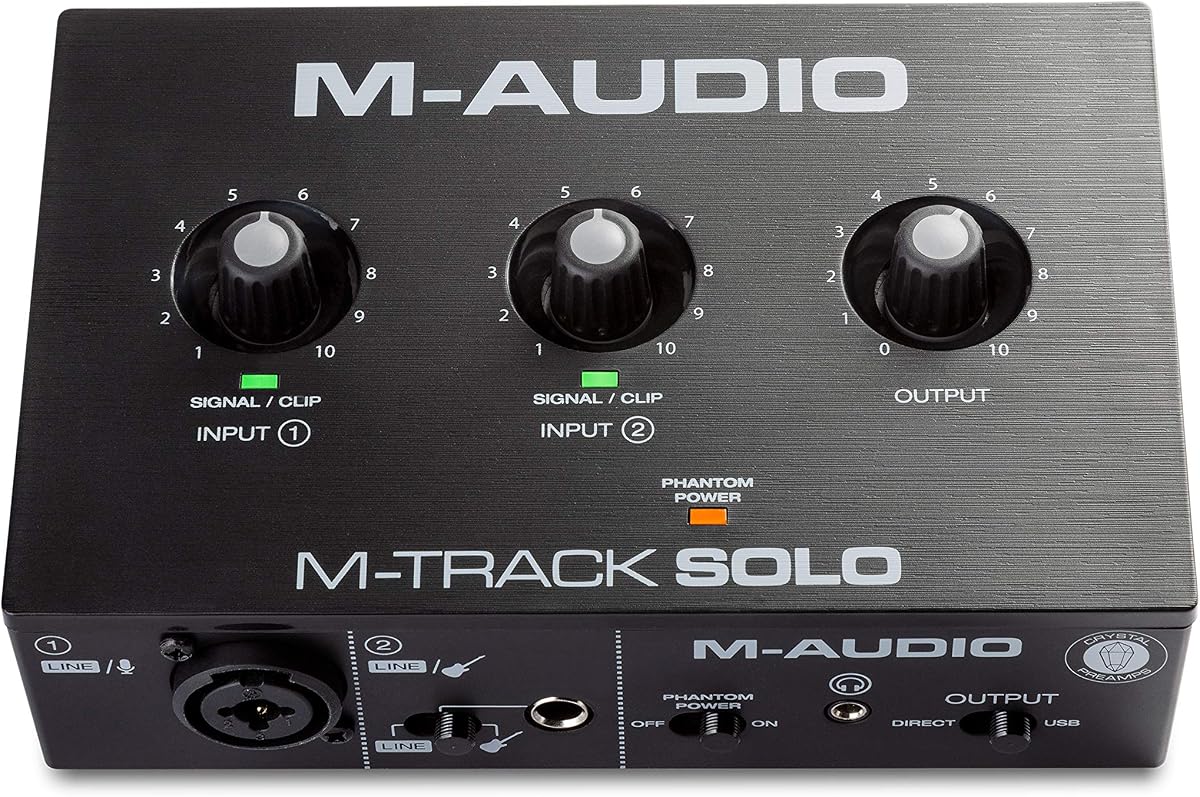
The M-AUDIO M-Track Solo is a compact audio interface designed for solo artists and podcasters needing simple recording capabilities. It has a 4.3 rating for its reliability and ease of use. This unit is perfect for quick setups on the go.
We may earn a commission when you buy through this link, at no additional cost to you.
It features one combo XLR input for microphones and one line/instrument input for guitars or synths. The 48kHz resolution is adequate for streaming and voiceover work. A USB/Direct switch enables zero latency monitoring to track performances without delay.
The use of RCA outputs instead of balanced TRS limits connection to consumer monitors or headphones. It is less suitable for professional studio mixing but great for basic tracking. The included MPC Beats software adds value for beginners learning production.
Ideal for solo creators who need a minimal footprint and straightforward recording solution. Its portability makes it perfect for field interviews or mobile content creation. Ensure your monitors support RCA inputs if using external speakers with this interface.
Compact size allows for easy transport in bags for mobile recording sessions.
One XLR and one instrument input cover most basic recording scenarios.
We may earn a commission when you buy through this link, at no additional cost to you.
The PreSonus AudioBox 96 25th Anniversary Edition is a value-packed interface known for its solid build and included software. It holds a 4.3 rating for its performance relative to cost. This model is a trusted choice for home studio beginners.
We may earn a commission when you buy through this link, at no additional cost to you.
It features two Class-A mic preamps that deliver clean and transparent gain for vocals and instruments. Recording up to 24-bit/96kHz ensures high fidelity for most production needs. It is bus-powered via USB 2.0 making it portable without needing an external power supply.
The included Studio One Artist DAW is a significant value add for those starting out in music production. However the 96kHz limit is lower than some competitors offering 192kHz support. Users should verify license transfer policies for the software after purchase.
Recommended for artists seeking a complete recording solution with minimal extra costs. Its balanced outputs ensure signal integrity when connecting to monitors or external gear. Verify computer compatibility with the DAW to ensure a smooth setup experience.
Includes Studio One Artist to provide a full production environment out of the box.
Draws power directly from USB allowing for true portable recording anywhere.
We may earn a commission when you buy through this link, at no additional cost to you.
Choosing the right audio interface requires understanding connectivity needs and budget constraints. These factors ensure you select a device that integrates smoothly with your PC and recording workflow.
Verify if your PC has Firewire ports or if you need a PCIe expansion card for legacy support. Modern interfaces use USB-C which simplifies cabling and power needs for most users.
Check your motherboard specs to ensure available slots before purchasing internal expansion cards to avoid compatibility issues.
Determine how many microphones and instruments you need to record simultaneously to select the correct channel count. Multi-channel interfaces are essential for bands while solo artists can often use two-channel models.
Ensure the interface offers the specific connectors you need such as XLR for mics and instrument inputs for guitars.
Look for interfaces supporting 24-bit audio with at least 96kHz sample rate for high-quality recordings. Higher resolutions capture more detail but require more storage and processing power.
Select a model with high-quality preamps to ensure clean gain without unwanted noise or distortion during recording.
Ensure the interface has stable drivers for your specific version of Windows to avoid connection issues or crashes. Legacy Firewire devices may require older drivers that are harder to find on modern systems.
Check user reviews for driver stability feedback to confirm consistent performance during long recording sessions.
Select an interface with direct monitoring to hear your audio in real time while recording without delay. This feature is critical for performers to stay in time with other tracks.
Confirm the interface includes a physical switch or software control to enable zero-latency monitoring easily.
Many interfaces include DAW software and plugins which can save money for beginners setting up their studio. Verify the software versions and license terms to ensure they meet your production needs.
Look for bundles that include essential tools like EQs and compressors to enhance your recording workflow immediately.
USB bus-powered interfaces simplify setup by eliminating the need for extra cables and wall outlets. This is beneficial for mobile recording but check wattage requirements for high-channel interfaces.
Ensure your computer USB ports provide sufficient power if opting for bus-powered models to avoid connection drops.
Check for digital I/O connections like ADAT or S/PDIF to connect additional interfaces for future growth. This expands your channel count without needing a new main interface for your PC.
Confirm available expansion slots or connections match your plans for adding more microphones or gear later.
Connect the interface to your PC using a compatible cable and ensure the driver is installed before launching your DAW. Adjust input gains to avoid clipping and set monitoring levels for comfortable listening during sessions.
Store the unit in a dry environment away from dust to prevent connection issues over time. Avoid dropping or placing heavy items on top to maintain structural integrity of ports.
Regularly check for firmware updates from the manufacturer to improve compatibility with newer operating systems. Clean external contacts with a soft cloth to ensure reliable connections with cables and adapters.
Modern PCs often lack native Firewire ports so you may need a PCIe expansion card to connect legacy devices. However most modern interfaces use USB-C or USB 3 which are widely supported without extra hardware.
Support varies and many legacy Firewire drivers may require legacy mode or specific configurations to work on Windows 11. Check with the manufacturer for updated drivers before purchase if you rely on older hardware.
Firewire offers higher bandwidth and lower latency which benefited older audio devices but USB 3 and USB-C have largely closed this gap. USB is more common on modern computers reducing the need for Firewire adapters.
Two-channel interfaces are often bus-powered via USB so no external supply is needed. Higher channel count models may require external power to handle increased data and signal loads efficiently.
Yes if your interface has multiple XLR inputs or ADAT expansion options. Each microphone requires a separate input channel to record simultaneously without overlap or distortion.
Enable direct monitoring on the interface or use your DAWs low-latency buffer settings to reduce delay. Keeping buffer sizes small helps real-time tracking for better performance alignment.
Selecting the best Firewire audio interface for PC depends on your specific needs for connectivity and recording quality. Our top picks cover options from budget-friendly models to high-end professional solutions.
Prioritize interfaces with strong driver support and features like direct monitoring to ensure a smooth recording experience on your system.
Always verify current pricing and availability before purchasing to secure the best deal for your studio setup.